

Britain won't run out of gas this Winter. It will pay for it.
posted 21st September 2026
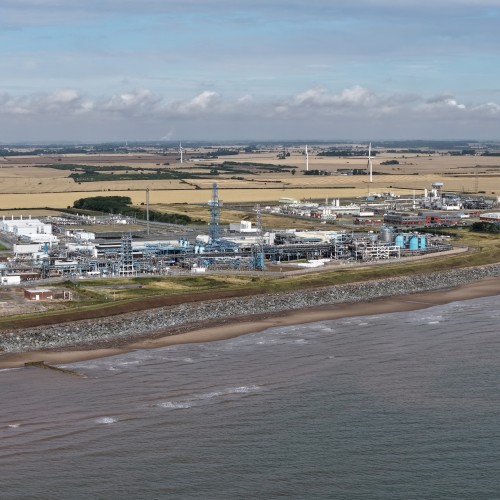
Britain’s largest gas store is empty. Centrica says Rough will stay that way through the Winter and close by spring unless it is brought into a regulatory support model, and its Chief Executive has warned that the UK has almost no gas in storage for the coming winter. Against the backdrop of the Hormuz crisis, headlines about shortages followed quickly but are often conflating two different risks. One is a physical shortfall, meaning not enough molecules to meet demand. The other is price. Our view is that the first is unlikely and the second has already happened.
The storage picture, honestly stated
The numbers are not pretty. British storage sits around 51% full, with Rough and Humbly Grove both empty, and European storage was only 68.66% full on 15 September. That leaves Europe entering winter with among the lowest inventories in two decades, well short of the EU’s 80% target. Britain’s position is structural and long-standing: at the time Rough reopened in 2022, the UK held roughly nine days of storage, against 89 in Germany, 103 in France and 123 in the Netherlands.
Storage was never how Britain got through winter
Storage is a small part of the GB winter supply stack. In winter 2024/25 storage withdrawals supplied 3.5 bcm of a 45.4 bcm total, against 15.4 bcm from the UKCS, 16.1 bcm from Norway and 9.8 bcm of LNG (Chart 1). That is under 8% of supply. National Gas notes that current GB storage is predominantly fast-cycling medium-range capacity, shaped by decades of indigenous production, whereas continental Europe relies on seasonal long-range storage. Our salt caverns are built for peak days and cold snaps, and they fill and empty several times a winter. They do not carry the season.
On peak days the picture is similar. National Gas put 2025/26 supply capability at 565 mcm/d against a 1-in-20 peak demand of 482 mcm/d (Chart 2). The storage figure within that was already reduced on the assumption that Rough would deliver nothing significant, and LNG terminal capacity has risen to 175 mcm/d after the South Hook and Isle of Grain expansions. The system was planned around an empty Rough a year ago. The 2026/27 outlook is due shortly, and we expect tighter margins but the same conclusion.
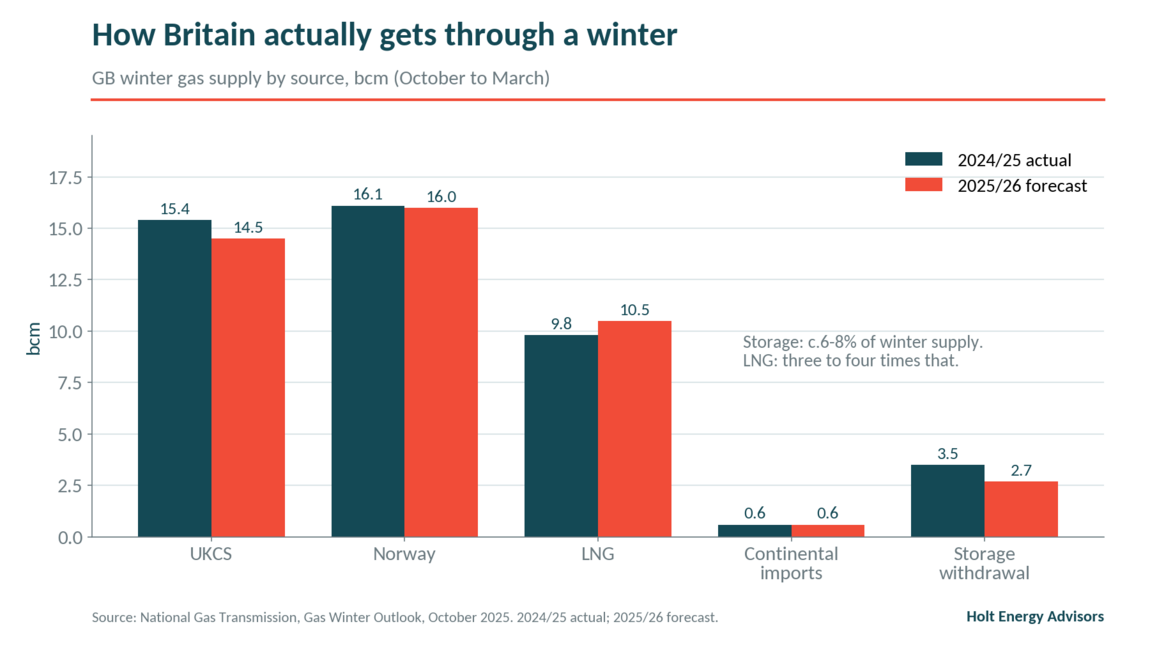
Chart 1: GB winter gas supply by source. Source: National Gas Transmission, Gas Winter Outlook, October 2025.
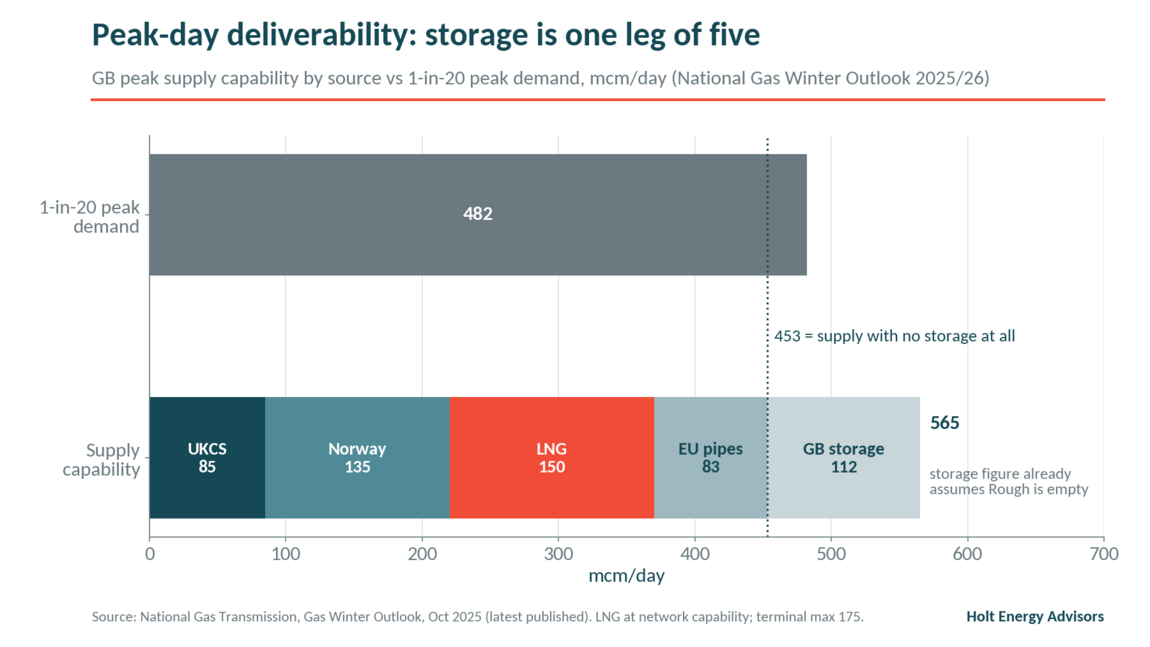
Chart 2: GB peak-day supply capability vs 1-in-20 peak demand. Source: National Gas Transmission, Gas Winter Outlook, October 2025
Point one: the LNG is there
This is the part of the argument that Hormuz makes harder. Qatar exported just 18 cargoes in the first six months of the war, against 509 in the same period a year earlier, and about 17% of its capacity is offline after strikes damaged two of its 14 trains. That removed roughly a fifth of global LNG supply.
The rest of the market has responded. The IEA reports that non-Gulf LNG output rose almost 18%, or around 27 bcm, between March and June, offsetting about three-quarters of the lost Gulf volumes. New North American and African trains are ramping up just as they are needed. Demand has adjusted too: the IEA expects Asian gas demand to fall 0.5% and European demand to fall more than 2% this year as high prices force fuel switching, and Chinese LNG imports fell 12%.
Britain is also less exposed to the Gulf than is often assumed. Last winter the United States supplied around 80% of our LNG. The arbitrage is wide open: Henry Hub is at $2.90/MMBtu while NBP spot is $25.59, almost nine times higher (Chart 3). Every flexible Atlantic cargo has a strong commercial reason to sail east, and Britain has the regasification capacity to take it.
The clearest evidence is what the system is doing now. NBP is currently the cheapest hub in Europe and Britain has been exporting gas to the Netherlands through BBL. A country that was short of gas would be importing through that pipe.
Point two: look at the price
NBP day-ahead was 104.4p/therm on 6 July. It reached 207.35p on 14 September and settled at 191.60p on the 17th (Chart 4). For context, day-ahead averaged 109.6p across winter 2024/25, and the front of the curve was near 70p last December. Spot has nearly doubled in ten weeks, and the new gas year has not yet started.
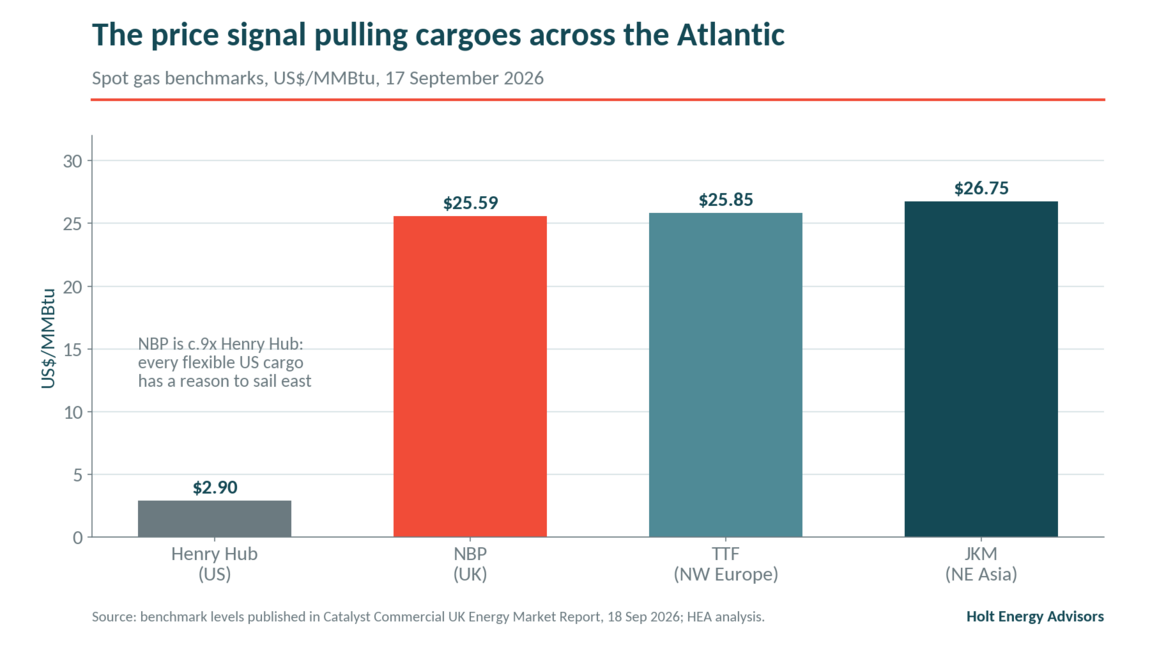
Chart 3: Spot gas benchmarks, 17 September 2026. Source: published benchmark levels; HEA analysis.
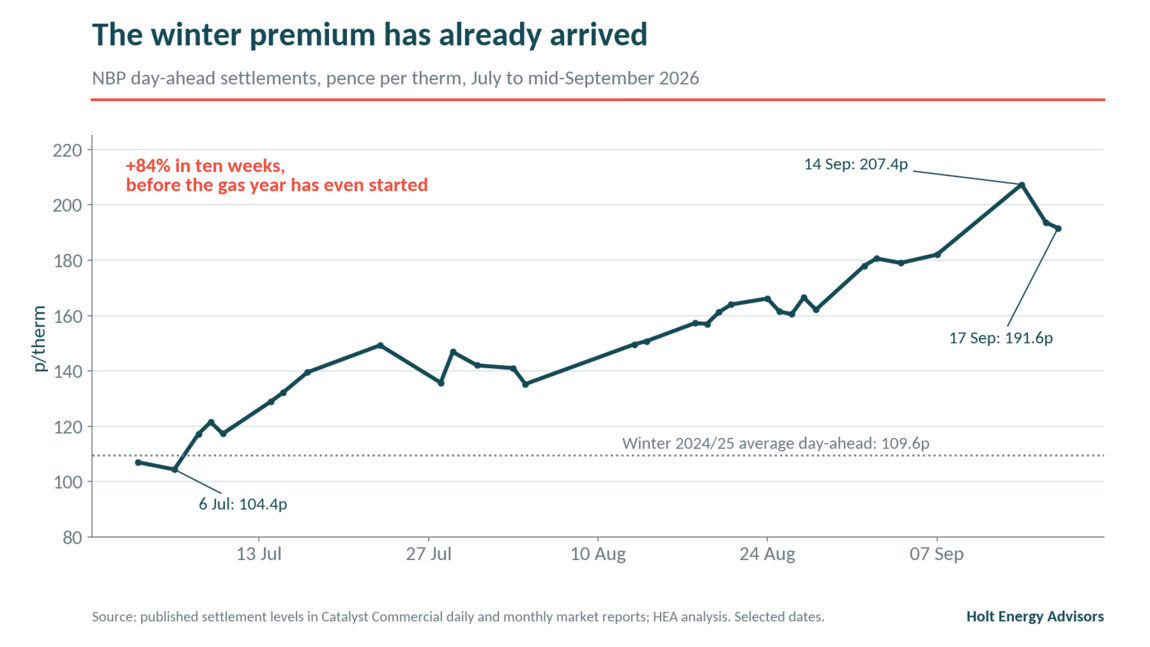
Chart 4: NBP day-ahead settlements, July to mid-September 2026. Source: published settlement levels; HEA analysis.
The shape of the curve is telling. Day-ahead, October and Winter-26 all settled within a couple of pence of each other around 191 to 193p, while Summer-27 was 130.52p and Winter-27 was 125.76p (Chart 5). We draw two conclusions from that.
First, the winter premium is already in the spot price. At around 190p, price is doing the job that storage does elsewhere. It attracts cargoes, it displaces gas from power generation, and it makes the marginal industrial user think hard about consumption. Britain pays for its security of supply through the spot price instead of through storage capex.
Second, the market sees a one-winter squeeze. The steep backwardation is also the reason Rough is empty, because with no summer-winter spread nobody is paid to inject gas. An empty Rough does not show that the market has failed to notice the risk. It shows how the market has chosen to price it.
What would prove us wrong
The thesis would fail under a cold, still winter across north-west Europe and north-east Asia at the same time. Wood Mackenzie’s chairman has suggested a colder-than-usual winter could take LNG from nearly $30 to $40/MMBtu, a level that would bring demand destruction. That is around 300p/therm. Peak-day margins are thin: under N-1 conditions last winter’s margin was 11 mcm/d, and National Gas’s cold-winter scenarios rely on imports from the continent, which is itself short this year. Norwegian reliability matters too: Troll currently has about 46 mcm/d curtailed after a compressor failure.
Even in that scenario, the sequence is price first, demand response second and emergency measures last. In 2022 Britain lost the marginal supplier to its neighbours, had a fifth of Rough available, saw prices above 500p, and the system still balanced.
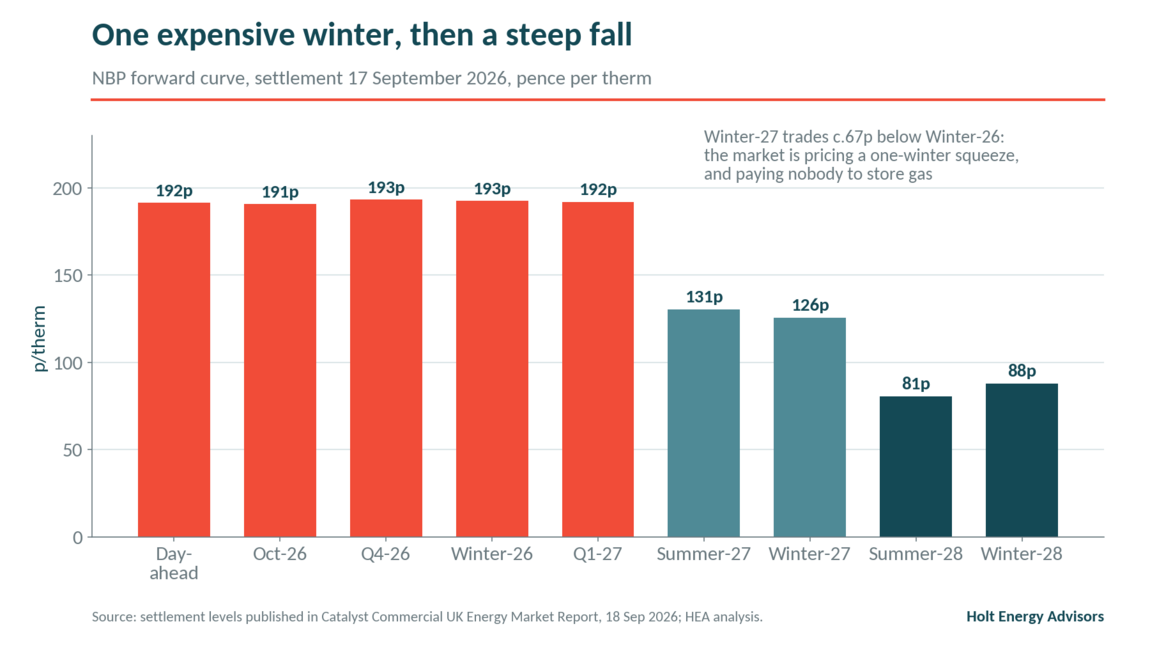
Chart 5: NBP forward curve, settlement 17 September 2026. Source: published settlement levels; HEA analysis.
The real debate
So we do not think the lights or the boilers go out this winter. What is in question is the cost of relying on the spot market to do what storage does for our neighbours. The debate on Rough should be framed that way: whether £2bn under a regulated model is cheaper insurance than winters like this one at 190p. After this winter, that may prove an easier case to make than it has been for a decade.